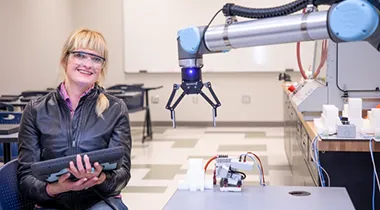
Wake Tech is dedicated to cultivating a skilled workforce for the manufacturing industry by establishing pathways for current and prospective workers to access opportunities in advanced manufacturing. Each training pathway is carefully designed to provide students with the skills required to excel in the technical and high-quality manufacturing jobs of the future.
The 3,000-square-foot Advanced Manufacturing Training Center serves the needs of area industry by providing workforce training in the following:
- Collaborative robotics – Robotics utilization, operation and basic programming
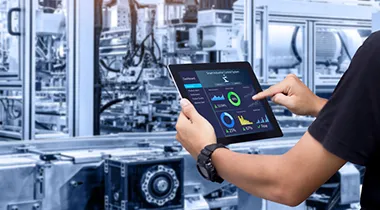
- Industrial automation – Automation systems, electrical, PLCs, hydraulics, pneumatics and mechanical systems
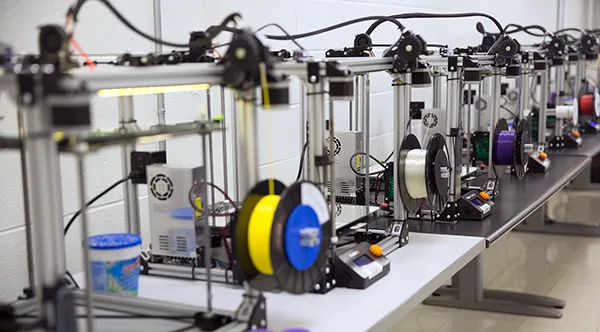
- Manufacturing – 3D printing, mechanical troubleshooting and mechanical blueprint reading
All programs include hands-on lab training supplemented with online instruction through Tooling University.
Come away with industry-recognized micro-credentials from the Smart Automation Certification Alliance and enhanced instruction from Tooling U-SME.

Faculty and staff

Chris Irwin
Program Director
~ Contact Info ~

William Burden
Advanced Manufacturing & Robotics Instructor
~ Contact Info ~

Bill Donaldson
Advanced Manufacturing & Robotics Instructor
~ Contact Info ~
Advanced Manufacturing Career Field Courses
Lean Six Sigma Yellow Belt
- Course ID: SEF-3001OQ2
- Overview
- Course Outline
- Requirements
- Intended Audience
- More Details
Course Objectives
Identify Six Sigma and Lean foundations and principles
Understand DMAIC Methodology
Use quality tools for successful application
Outline of Instruction
Introduction to Lean Six Sigma, LSS History, Principles and Strategy, LSS Typical Benefits, Yellow Belt Roles and Responsibilities, Eight Wastes, 5S, Standard Work, Process Flow, Pull vs. Push, Visual Controls and Management, Theory of Constraints (ToC)
DMAIC Framework, Organizational Functions vs. Process, Understanding Variation, Project Charters, SIPOC Diagrams, Voice of the Customer, Value Stream Mapping, Cause and Effects Analysis, 5 Whys, Mistake Proofing, Point of Use, Control Plans
Contact Hours
8
CEUs
Yes
Industry Standard, State or National Certification
Certification
None
Website
None
Certification Learning Outcomes/Requirements
CE or CU Articulation
No
Prerequisites
None
Learning Supplies Needed
What is Lean Six Sigma
Clinical Site/Special Facilities
None
Requirements for Successful Completion
100% attendance
Accreditation/Special Approval Requirements
N/A
Intended Audience
For leaders and emerging leaders in the workforce.
Specific Industry or Business Support Needs
N/A
Wake County Need for Industry Positions
N/A
Industry or Job Titles Related to Training Outcomes for Employment
No active courses available at this time.
To be notified when this course becomes available, please use
Wake Tech’s Notify Me service
for SEF-3001OQ2-Lean Six Sigma Yellow Belt
.
Six Sigma: Total Quality Fundamentals
- Course ID: MLS-3230JE
- Overview
- Course Outline
- Requirements
- Intended Audience
- More Details
Course Objectives
Learn the fundamentals, history, and key concepts of the total quality movement.
Study how to increase the value of your company through motivational models, leadership, teamwork, and quality standards.
Outline of Instruction
Lesson 1 - Introduction to Quality
Lesson 2 - Customers and Organization
Lesson 3 - Nonquality Costs and Variation
Lesson 4 - Assessment and Leadership
Lesson 5 - Motivation and Change
Lesson 6 - Team Building and Training
Lesson 7 - TEI and Measuring Performance
Lesson 8 - Standards and Auditing
Lesson 9 - External and Internal Auditing
Lesson 10 - ISO 9000
Lesson 11 - More Standards and Systems
Lesson 12 - Quality Culture and Fallacies
Contact Hours
24
CEUs
No
Industry Standard, State or National Certification
Certification
None
Website
None
Certification Learning Outcomes/Requirements
CE or CU Articulation
No
Prerequisites
There are no prerequisites to take this course.
Learning Supplies Needed
Hardware Requirements:
This course can be taken on either a PC, Mac, or Chromebook.
Software Requirements:
PC: Windows 8 or later.
Mac: macOS 10.6 or later.
Browser: The latest version of Google Chrome or Mozilla Firefox are preferred. Microsoft Edge and Safari are also compatible.
Adobe Acrobat Reader.
Software must be installed and fully operational before the course begins.
Other:
Email capabilities and access to a personal email account.
Instructional Material Requirements:
The instructional materials required for this course are included in enrollment and will be available online.
Clinical Site/Special Facilities
None
Requirements for Successful Completion
90% attendance
• Students must successfully pass 10 quizzes with a minimum grade of 70% by the second quiz attempt.
• If all quizzes are not passed with 70 or better by the second attempt, the final exam score must be 70% or higher on the first attempt for successful completion.
• The Final Exam must be taken by the Wake Tech course end date.
Accreditation/Special Approval Requirements
N/A
Intended Audience
If you are interested in learning how to increase the value of your company through motivational models, leadership, teamwork, and quality standards, this course is for you!
Specific Industry or Business Support Needs
N/A
Wake County Need for Industry Positions
N/A
Industry or Job Titles Related to Training Outcomes for Employment
No active courses available at this time.
To be notified when this course becomes available, please use
Wake Tech’s Notify Me service
for MLS-3230JE-Six Sigma: Total Quality Fundamentals
.
Certified Manufacturing Associate
- Course ID: MFG-3111A1
- Overview
- Course Outline
- Requirements
- Intended Audience
- More Details
Covering fundamental topics such as shop math, assembly, maintenance, machining, inspection and more, this industry-driven certification demonstrates that the individual has basic knowledge of manufacturing and may be an ideal candidate for entry-level manufacturing employment.
Course Objectives
Outline of Instruction
Safety
Quality and Lean
Inspection
Fastener
CNC
Robotics
Additive Manufacturing
Contact Hours
110
CEUs
No
Industry Standard, State or National Certification
Certification
Society of Manufacturing Engineers (SME)
Website
https://www.sme.org/training/certifications/assessments/certified-manuf…
Certification Learning Outcomes/Requirements
CE or CU Articulation
No
Prerequisites
A high school diploma is required, and students must demonstrate math and reading competency at the eighth- to 10th-grade level on an in-person entrance test.
Learning Supplies Needed
N/A
Clinical Site/Special Facilities
N/A
Requirements for Successful Completion
100% attendance
Accreditation/Special Approval Requirements
Assess your knowledge and experience, preparation materials for the CMfgA certification, review the exam, preparation tips, apply for the exam, schedule the exam, secure an exam proctor, take the exam
Intended Audience
Specific Industry or Business Support Needs
N/A
Wake County Need for Industry Positions
N/A
Industry or Job Titles Related to Training Outcomes for Employment
Related Courses
Course Contact Information
Seyyed Hessam Mir Shah Ghassemi
919-866-5158
[email protected]
| Details | Section | Date(s) | Location | Price | Seats | |
|---|---|---|---|---|---|---|
| 335954 | 10/26/26 - 12/15/26 | Online | 358.00 | 24 |
Course Cancelled
|
If you would like to be notified when additional sections become available, please use Wake Tech’s Notify Me service for MFG-3111A1-Certified Manufacturing Associate .
Mechatronics Technologist
- Course ID: ATR-3115G1
- Overview
- Course Outline
- Requirements
- Intended Audience
- More Details
Course Objectives
By completing this course, the student will earn SACA credentials and will be prepared for employment in advanced manufacturing facilities that utilize smart manufacturing principles.
C-201 Electrical Systems 1
Prepares individuals to connect, adjust, operate, troubleshoot and analyze electrical circuits using basic electrical components: resistors, capacitors, inductors, DC motors, solenoids, manual switches, relays, fuses, circuit breakers, transformers and indicators. Other key skills include adhering to electrical safety rules, reading electrical circuit diagrams, applying Ohm's Law and Kirchhoff's Law, using digital multimeters, interpreting series/parallel circuits and assessing power/circuit protection.
C-202 Electric Motor Control Systems 1
Prepares individuals to connect, adjust and operate electrical motor control circuits using these electrical components: 3-phase AC motors, reversing magnetic motor starters with overloads, drum switches, control relays, timer relays, push-button switches, selector switches, limit switches, pressure switches and float switches. Other key skills include adhering to motor control safety rules, reading ladder logic circuit diagrams, checking for proper ground connections, wiring motors for high and low voltage and interpreting common motor control application circuits.
C-209 Pneumatic Systems 1
Prepares individuals to connect, adjust, operate and analyze pneumatic circuits using these components: quick-connect fittings, tee and cross fittings, air compressors, filters, regulators, lubricators, gauges, rotameters, directional control valves, flow control valves, check valves, cylinders and motors. Other key skills include adhering to pneumatic safety rules, reading pneumatic circuit symbols and diagrams, applying the Force-Pressure-Area formula, converting absolute/gauge pressure units, performing reciprocating compressor startup/shutdown, applying Pascal's Law, setting pressure switch, filter draining, setting lubricator rate, lubricator refilling and measuring delta P.
C-304 Pneumatic Troubleshooting 1
Prepares individuals to troubleshoot and remedy faults in electro-pneumatic PLC-controlled systems. Skills include adhering to troubleshooting safety rules, systems troubleshooting, component testing and using digital multimeters and status indicators. Components include filters, regulators, lubricators, solenoid-operated directional control valves, flow control valves, vacuum generators, vacuum cups, vacuum switches, quick exhaust valves, limit switches, electronic sensors, PLC I/O modules, check valves, cylinders and motors.
C-207 Programmable Controller Systems 1
Prepares individuals to program, configuration, adjust, monitor and operate industrial programmable logic controller (PLC) systems. Key skills include adhering to PLC safety rules, performing normal startup/shutdown, operating PLC in different modes, performing emergency shutdown and reset, monitoring for proper operation through indicators and PC-based PLC software, configuring processor software drivers for communication to a PC, configuring and loading of HMI programs, operating HMI with PLC, configuring PLC discrete I/O, transferring programs between PC and PLC processor, interpreting basic and intermediate level PLC ladder logic programs (with contacts, coils, timers, counters, math, comparison instructions), PLC project creation/editing, and interpreting common PLC program logic applications using electro-pneumatic actuators and on/off motor control systems.
C-210 Mechanical Power Systems I
Prepares individuals to install, adjust, align, tension, operate and analyze basic mechanical power transmission drive systems using these components: motors, shafts, flexible jaw couplings, fractional horsepower (FHP) chain drives, FHP V-belt drives, spur gear drives, pillow block bearings and flange bearings. Other key skills include adhering to mechanical drive safety rules, mounting and leveling motors, testing and correcting for soft foot, installing components and shafts with keyways, sizing keys, aligning shafts using feeler-gauge and straight-edge method, calculating speed and torque from component size ratios, interpreting rotary power specifications, determining mechanical efficiency, greasing bearings using a grease gun, refilling oil lubrication reservoirs, interpreting lubrication specifications and identifying component given a model number.
C-301 Mechanical Power Systems 2
Prepares individuals to install, adjust, align, tension, operate, troubleshoot, maintain and analyze heavy-duty mechanical power transmission drive systems using these components: motors, shafts, gear/grid/flange couplings, QD/taper lock/split taper bushings, multiple belt/timing/HTD belt drives, and heavy duty/silent chain drives. Other key skills include adhering to mechanical drive troubleshooting safety rules, performing reverse dial indicator shaft alignment, identifying components given a model number, selecting/sizing components for a given application and identifying/correcting component wear.
Outline of Instruction
NFPA 70E
Fire Suppression & Lockout Tagout
PPE
Manufacturing Safety (machinery dangers, noise pollution, electrical components, chemicals, workplace accidents, inadequate training, communication skills)
Introduction to Troubleshooting Skills
Introduction to Productive Maintenance
Math Review
AC/DC Electrical Systems (SACA C-201 Silver and Gold assessments)
Electrical Motor Control (SACA C-202 Silver and Gold assessments)
Pneumatic Systems (SACA C-209 Silver and Gold assessments)
Pneumatics Troubleshooting (SACA C-304 Silver and Gold assessments)
PLCs (SACA C-207 Silver and Gold assessments)
Mechanical Power Systems 1 (SACA C-210 Silver and Gold assessments)
Mechanical Power Systems 2 (SACA C-301 Silver and Gold assessments)
Retests
Blueprint & Schematic Reading
Concepts of Smart Manufacturing
Contact Hours
472
CEUs
Yes
Industry Standard, State or National Certification
Certification
Smart Automation Certification Alliance (SACA)
Website
https://www.saca.org/smart-automation-certifications/
Certification Learning Outcomes/Requirements
C-209 Pneumatic Systems 1
C-304 Pneumatic Troubleshooting 1
C-207 Programmable Controller Systems 1
C-210 Mechanical Power Systems 1
C-301 Mechanical Power Systems 2
CE or CU Articulation
Electronics Engineering Technology AAS degree courses (ELC-228: PLC Applications and WBL- 111DI: Work-Based Learning I); Mechanical Engineering Technology and Mechatronics AAS degree courses (MEC-130: Mechanisms and WBL- 111DJ: Work-Based Learning I)
Prerequisites
High school diploma, GED or equivalent; at least 18 years of age; 10th-grade reading level or higher
Learning Supplies Needed
Amatrol online-learning LMS and/or books covering electrical systems, motor control systems, pneumatic systems and mechanical power systems, along with access to related blueprint and schematics reading materials
Clinical Site/Special Facilities
N/A
Requirements for Successful Completion
90% attendance
Completion of all assignments,Completion of all graded assignments/assessments with a score of 70% or higher
Accreditation/Special Approval Requirements
N/A
Intended Audience
Students interested in becoming employed in entry-level advanced manufacturing positions, or anyone already employed in the field seeking to gain industry-recognized credentials
Specific Industry or Business Support Needs
Mechatronics technician, mechatronics technologist, electromechanical technologist, electromechanical technician, light automation technician
Wake County Need for Industry Positions
The manufacturing industry is increasingly reliant on advanced technologies, creating a high demand for skilled workers. Wake County has a growing manufacturing industry comprised of domestic and international organizations in need of a skilled, trained workforce to support their manufacturing initiatives.
Industry or Job Titles Related to Training Outcomes for Employment
Mechatronics technician
Mechatronics technologist
Electromechanical technologist
Electromechanical technician
Light automation technician
No active courses available at this time.
To be notified when this course becomes available, please use
Wake Tech’s Notify Me service
for ATR-3115G1-Mechatronics Technologist
.
Certified Manufacturing Associate
- Course ID: MFG-3111B8
- Overview
- Course Outline
- Requirements
- Intended Audience
- More Details
Covering fundamental topics such as shop math, assembly, maintenance, machining, inspection and more, this industry-driven certification demonstrates that the individual has basic knowledge of manufacturing and may be an ideal candidate for entry-level manufacturing employment.
Course Objectives
Outline of Instruction
Safety
Quality and Lean
Inspection
Fastener
CNC
Robotics
Additive Manufacturing
Contact Hours
60
CEUs
Yes
Industry Standard, State or National Certification
Certification
Society of Manufacturing Engineers (SME)
Website
https://www.sme.org/training/certifications/assessments/certified-manuf…
Certification Learning Outcomes/Requirements
CE or CU Articulation
No
Prerequisites
A high school diploma is required, and students must demonstrate math and reading competency at the eighth- to 10th-grade level on an in-person entrance test.
Learning Supplies Needed
N/A
Clinical Site/Special Facilities
N/A
Requirements for Successful Completion
100% attendance
Accreditation/Special Approval Requirements
N/A
Intended Audience
Specific Industry or Business Support Needs
N/A
Wake County Need for Industry Positions
N/A
Industry or Job Titles Related to Training Outcomes for Employment
Related Courses
Course Contact Information
Seyyed Hessam Mir Shah Ghassemi
919-866-5158
[email protected]
No active courses available at this time.
To be notified when this course becomes available, please use
Wake Tech’s Notify Me service
for MFG-3111B8-Certified Manufacturing Associate
.
Certified Manufacturing Associate
- Course ID: MFG-3111A8
- Overview
- Course Outline
- Requirements
- Intended Audience
- More Details
Covering fundamental topics such as shop math, assembly, maintenance, machining, inspection and more, this industry-driven certification demonstrates that the individual has basic knowledge of manufacturing and may be an ideal candidate for entry-level manufacturing employment.
Course Objectives
Outline of Instruction
Safety
Quality and Lean
Inspection
Fastener
CNC
Robotics
Additive Manufacturing
Contact Hours
110
CEUs
No
Industry Standard, State or National Certification
Certification
Society of Manufacturing Engineers (SME)
Website
https://www.sme.org/training/certifications/assessments/certified-manuf…
Certification Learning Outcomes/Requirements
CE or CU Articulation
No
Prerequisites
A high school diploma is required, and students must demonstrate math and reading competency at the eighth- to 10th-grade level on an in-person entrance test.
Learning Supplies Needed
N/A
Clinical Site/Special Facilities
N/A
Requirements for Successful Completion
100% attendance
Accreditation/Special Approval Requirements
N/A
Intended Audience
Specific Industry or Business Support Needs
N/A
Wake County Need for Industry Positions
N/A
Industry or Job Titles Related to Training Outcomes for Employment
No active courses available at this time.
To be notified when this course becomes available, please use
Wake Tech’s Notify Me service
for MFG-3111A8-Certified Manufacturing Associate
.
Lean Six Sigma Yellow Belt
- Course ID: SEF-3001B8
- Overview
- Course Outline
- Requirements
- Intended Audience
- More Details
Course Objectives
Identify Six Sigma and Lean foundations and principles
Understand DMAIC Methodology
Use quality tools for successful application
Outline of Instruction
Introduction to Lean Six Sigma
LSS History
Principles and Strategy
LSS Typical Benefits
Yellow Belt Roles and Responsibilities
Eight Wastes
5S
Standard Work
Process Flow
Pull vs. Push
Visual Controls and Management
Theory of Constraints (ToC)
DMAIC Framework
Organizational Functions vs. Process
Understanding Variation
Project Charters
SIPOC Diagrams
Voice of the Customer
Value Stream Mapping
Cause and Effects Analysis
5 Whys
Mistake Proofing
Point of Use
Control Plans
Contact Hours
8
CEUs
Yes
Industry Standard, State or National Certification
Certification
None
Website
None
Certification Learning Outcomes/Requirements
CE or CU Articulation
No
Prerequisites
N/A
Learning Supplies Needed
"What is Lean Six Sigma"
Clinical Site/Special Facilities
N/A
Requirements for Successful Completion
100% attendance
Accreditation/Special Approval Requirements
N/A
Intended Audience
For leaders and emerging leaders in the workforce
Specific Industry or Business Support Needs
N/A
Wake County Need for Industry Positions
N/A
Industry or Job Titles Related to Training Outcomes for Employment
No active courses available at this time.
To be notified when this course becomes available, please use
Wake Tech’s Notify Me service
for SEF-3001B8-Lean Six Sigma Yellow Belt
.
Mechanical Drive Systems
- Course ID: MEC-9000A8
- Overview
- Course Outline
- Requirements
- Intended Audience
- More Details
Mechanical systems are the driving force behind most industrial applications, with gears, drives, bearings, pulleys and more found in nearly everything that moves. The Mechanical Systems certification covers the installation, use, maintenance and troubleshooting of mechanical drive components and systems. The curriculum is organized into topics focused on industry-relevant components, emphasizing practical, hands-on tasks to develop expertise in operating and maintaining these essential systems. Students take their third-party (SACA) certifications assessments at the end of the course.
Course Objectives
Understand the installation, use, maintenance and troubleshooting of mechanical drive components and systems.
Outline of Instruction
Safety protocols and risk management strategies
Mechanical system design principles
Mechanical properties of materials
Introduction to mechanical drive systems
Belt, chain and gear drives
Couplings and shaft alignment
Bearings and linear bearings
Gaskets, seals, ball screws, clutches and brakes
Laser alignment, lubrication and vibration analysis
Certifications and practical assessments
Contact Hours
64
CEUs
Yes
Industry Standard, State or National Certification
Certification
National Coalition of Certification Centers (NC3)
Website
Certification Learning Outcomes/Requirements
Proper safety protocols associated with performing work on mechanical systems
Understanding of belt drives and their roles in industrial applications
Proper installation of belt drives and the importance of following specific protocols
Identification of the main components of the belt drive systems in industrial installations
Understanding of chain drives and their roles in industrial applications
Proper installation of chain drives and the importance of following specific protocols
Identification of the main components of chain drive systems in industrial installations
Understanding of gear drives and their roles in industrial applications
Proper installation of gear drives and the importance of following specific protocols
Identification of the main components of gear drive systems in industrial installations
CE or CU Articulation
MEC-130 - Mechanisms
Prerequisites
High school graduate or GED, at least 18 years old, reading level of 10th grade or higher
Learning Supplies Needed
N/A
Clinical Site/Special Facilities
Lab facility with related Festo Mechanical Drives trainers and equipment.
Requirements for Successful Completion
90% attendance
Completion of all assigned objectives
Accreditation/Special Approval Requirements
NC3-certified instructors
Intended Audience
This course is intended for personnel who wish to be employed in an industry position that utilizes Manufacturing Production Technicians, Industrial Maintenance Technicians, Mechanical Power Transmission Technicians and Installers.
Specific Industry or Business Support Needs
Manufacturing production technician, industrial maintenance technician, manufacturing technologist/engineer and reliability/maintenance engineer
Wake County Need for Industry Positions
There is a skill gap area for manufacturing in Wake County and the Triangle area that is dependent on manufacturing and production skilled technicians to keep manufacturing systems operating.
Industry or Job Titles Related to Training Outcomes for Employment
Manufacturing production technician
Industrial maintenance technician
Manufacturing technologist
Manufacturing engineer
Reliability/maintenance engineer
Related Courses
Course Contact Information
Seyyed Hessam Mir Shah Ghassemi
919-866-5158
[email protected]
| Details | Section | Date(s) | Location | Price | Seats | |
|---|---|---|---|---|---|---|
| 336375 | 10/26/26 - 12/15/26 | Online | 358.00 | 8 | Register |
If you would like to be notified when additional sections become available, please use Wake Tech’s Notify Me service for MEC-9000A8-Mechanical Drive Systems .